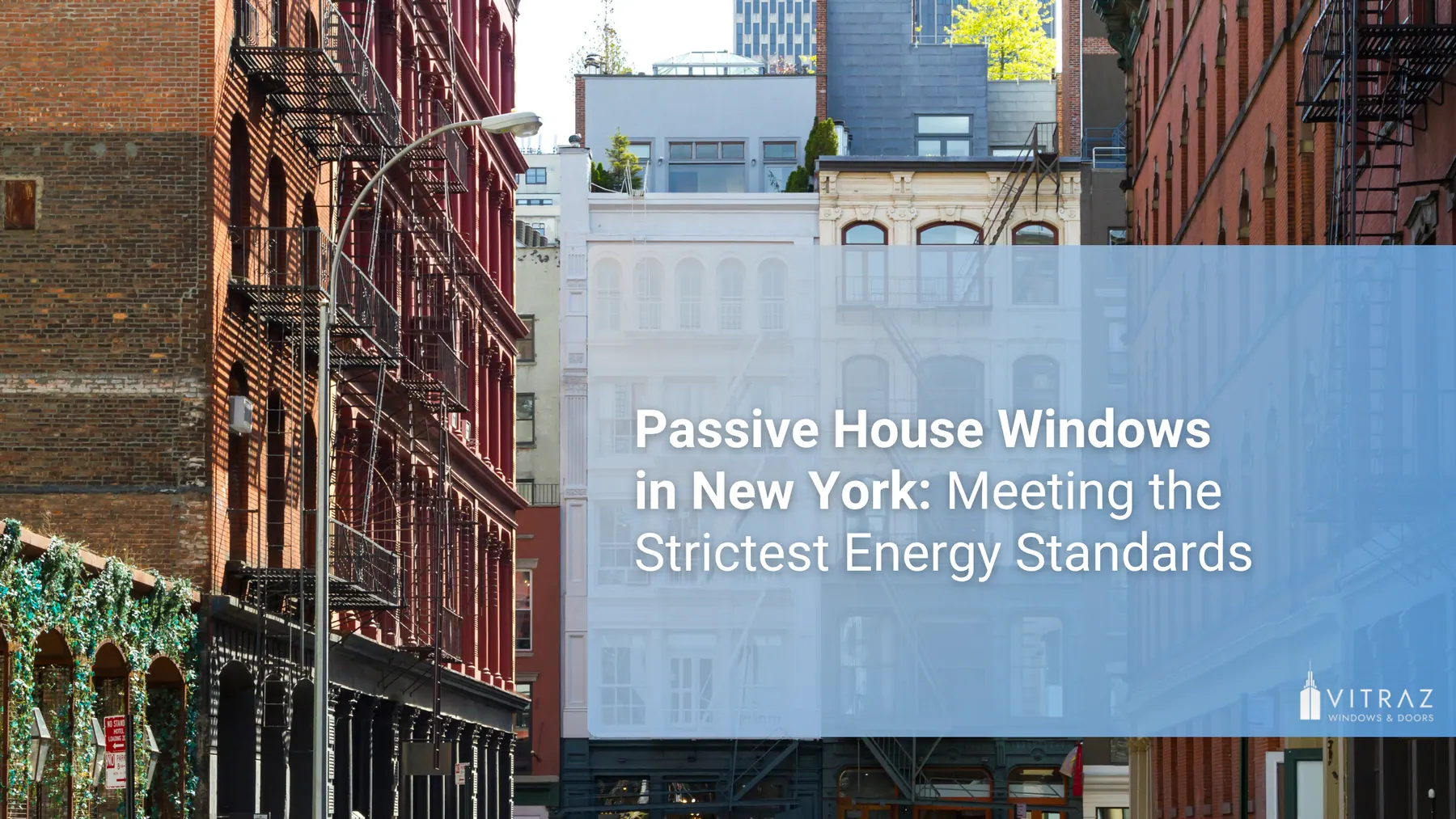
Passive House Windows in New York: Meeting the Strictest Energy Standards
Energy standards in New York are getting tougher, and the Passive House movement is leading the way. Whether you are an architect designing a high-performance building, a developer chasing certification, or a homeowner who wants the most efficient home possible, the windows you choose will make or break your results. Glazing is one of the weakest points in any building envelope, which is why Passive House projects demand windows engineered to an entirely different level.
At Vitraz Windows and Doors, we fabricate the MB-104 Passive aluminum window and door system, a platform built specifically for projects with the most demanding thermal requirements. As a Brooklyn-based fabricator serving the NYC metro area and beyond, we help builders and homeowners meet these standards without sacrificing design. Here is what Passive House windows are, why they matter in New York, and how to choose them well.
This guide is written for architects, developers, builders, and homeowners who are serious about energy performance and want to understand how windows fit into a Passive House or high-performance project. We will cover what the standard requires, why glazing is so decisive, how the MB-104 Passive system meets the bar, and the practical considerations that determine whether a project succeeds. Even if you are not pursuing formal certification, the same principles produce a dramatically better building.
What Passive House Means
Passive House is a rigorous building performance standard focused on dramatically reducing the energy a building needs for heating and cooling. The idea is to design an envelope so well insulated and so airtight that the building stays comfortable with very little active heating or cooling, relying instead on good design, controlled ventilation, and minimal energy input.
To reach that goal, every part of the envelope has to perform, and windows are scrutinized closely because glass and frames are where heat most easily escapes. Passive House projects require windows with exceptional insulation, airtight seals, and careful detailing to avoid thermal bridges, the weak points where heat sneaks through.
This is not only about formal certification. The same principles produce a more comfortable, quieter, healthier building with far lower energy bills, which is why Passive House thinking is spreading well beyond officially certified projects.
Why Windows Are the Critical Component
A wall can be packed with insulation, but a window is a much thinner barrier against the outside world. In a poorly chosen window, heat escapes through the glass, through the frame, and through gaps where air leaks in and out. In a New York winter that means cold drafts and high heating bills, and in summer it means unwanted heat gain and harder-working air conditioning.
Passive House windows attack all three weak points at once. They use advanced glazing to slow heat transfer through the glass, highly insulated frames to stop heat from passing through the metal, and precise seals to eliminate air leakage. Getting all three right is what allows a window to meet the standard rather than undermine it.
This is exactly why the frame system matters so much. A high-performance glass unit set into a poorly insulated frame will still fail, because the frame becomes the weak link. The MB-104 Passive system is engineered as a complete high-performance assembly, frame and glazing working together.
Inside the MB-104 Passive System
The MB-104 Passive system is a European aluminum platform designed for the highest thermal demands. Its defining feature is a deep, advanced thermal break within the frame. A thermal break is an insulating barrier that separates the inner and outer parts of the aluminum so heat cannot travel straight through the metal. The deeper and better engineered that break, the better the frame insulates, and this system is built for top-tier performance.
The system accommodates triple glazing, with two insulating gaps filled with inert gas and multiple low-emissivity coatings that reflect heat back where it belongs. It also incorporates multiple layers of weather seals to achieve the airtightness that Passive House requires. The result is a window that keeps interiors warm in winter, cool in summer, and free of the drafts that plague conventional units.
Importantly, all of this performance comes in slim, modern aluminum profiles. You do not have to choose between energy efficiency and clean architectural design, which is often the trade-off with bulkier high-performance window systems.
The Real Benefits for New York Buildings
The advantages of Passive House windows go well beyond a certificate on the wall. They translate into tangible improvements that owners feel every day:
• Significantly lower heating and cooling bills, since the building loses far less energy through its windows.
• Consistent indoor comfort with no cold spots near the glass and no drafts in winter.
• Better sound insulation, a major benefit on noisy city streets, thanks to triple glazing and tight seals.
• Reduced condensation, because warm interior glass surfaces resist the moisture buildup that damages frames and sills.
• A smaller carbon footprint and a building that is ready for increasingly strict energy codes.
For developers, these benefits also support marketing and long-term value. Energy-efficient, certified buildings appeal to a growing segment of buyers and tenants who care about both comfort and operating costs.
Meeting New York Energy Codes
New York City and State have moved aggressively on building energy performance, and the requirements continue to tighten. Projects that once met code comfortably can fall short under newer standards, and windows are frequently where compliance is won or lost.
Specifying a high-performance system like the MB-104 Passive gives a project real headroom. Rather than scraping past minimum requirements, the building benefits from windows that exceed them, which simplifies compliance and protects the project against future code changes. For architects and developers, that is a practical reason to invest in better glazing from the start rather than retrofitting later.
Design Without Compromise
A frequent misconception is that ultra-efficient windows must be bulky or visually heavy. With the MB-104 Passive system, that is not the case. The aluminum profiles remain slim and clean, the glass area stays generous, and the finished window suits modern and traditional architecture alike.
Because Vitraz fabricates each unit to order, the system can be configured as fixed windows, tilt-and-turn windows, doors, and large glazed assemblies, all while maintaining Passive House level performance. That flexibility lets designers pursue an ambitious aesthetic and an ambitious energy target at the same time.
The Numbers Behind Window Performance
Window performance is measured, and understanding the basic metrics helps you make informed decisions. The most important is the U-value, which measures how readily heat passes through the window. A lower U-value means better insulation and less heat loss. Passive House and high-performance projects demand very low U-values across the whole window, including the frame, not just the center of the glass, because the frame and edges are where many windows fall down.
This whole-window perspective is crucial. A window can have excellent glass but a poorly insulated frame, and the overall performance will suffer accordingly. This is why the frame system is so important and why a deep, well-engineered thermal break is central to a high-performance window. Other factors, such as the solar heat gain coefficient, describe how much of the sun’s heat the glazing admits, which matters for balancing winter warmth against summer overheating.
You do not need to become an engineer to benefit from understanding these basics. The key takeaway is that real performance comes from the complete window working as a system, and that is exactly how high-performance platforms like the MB-104 Passive are designed.
Airtightness and Why It Matters So Much
Insulation gets most of the attention, but airtightness is just as important to a high-performance building, and windows are a frequent source of air leakage. Even a well-insulated window leaks energy if air can pass around the sash or through gaps in the seals. Those leaks let warm air escape in winter and hot, humid air infiltrate in summer, undermining comfort and driving up energy use.
Passive House standards set demanding airtightness targets for the building as a whole, and windows have to contribute rather than detract. The MB-104 Passive system uses multiple layers of weather seals and precise tolerances to achieve a tight closure that resists air leakage. Combined with correct installation, where the window is properly sealed to the surrounding structure, this delivers the airtight performance the standard requires.
The benefits of airtightness extend beyond energy. A tightly sealed building, ventilated deliberately through a controlled system, enjoys better indoor air quality and comfort than a leaky one where air sneaks in unpredictably. Windows that seal properly are foundational to that outcome.
Avoiding Thermal Bridges
A thermal bridge is a path through the building envelope that conducts heat more readily than the surrounding materials, creating a weak point for heat loss and a potential site for condensation. Windows are classic locations for thermal bridges, both within the window itself and at the junction where the window meets the wall.
Within the window, an inadequate thermal break in the frame creates a bridge straight through the aluminum. The MB-104 Passive system addresses this with a deep, advanced thermal break that interrupts that path effectively. At the installation junction, careful detailing is required to ensure the window is integrated into the wall’s insulation layer without creating a gap that heat can exploit.
This is where the partnership between a quality window system and skilled installation becomes essential. The best window in the world can be compromised by poor installation detailing, and conversely, careful installation gets the most out of a high-performance system. For Passive House results, both have to be right.
Comfort, Health, and Quiet
It is easy to focus on energy savings and forget that high-performance windows also make a building far more pleasant to occupy. With warm interior glass surfaces, there are no cold drafts pooling near the windows and no chilly zones that make a room uncomfortable in winter. The temperature feels even throughout the space, which is a comfort difference people notice immediately.
Health benefits follow as well. Warm interior surfaces resist condensation, which means less moisture, less mold risk, and a healthier indoor environment. The triple glazing typical of Passive House windows also blocks sound very effectively, delivering a quiet interior even on a busy New York street. For homes and workplaces alike, that quiet is a genuine quality-of-life improvement.
These benefits are why Passive House thinking appeals to people well beyond those chasing certification. The comfort, health, and quiet are reasons enough to choose high-performance windows even when energy savings are not the primary motivation.
Is Passive House Right for Your Project
Not every project pursues formal Passive House certification, and that is fine. The valuable insight is that the principles behind the standard, namely excellent insulation, airtightness, and the elimination of thermal bridges, produce a better building regardless of whether you seek a certificate. You can adopt high-performance windows to capture most of the comfort and efficiency benefits even on a conventional project.
For projects that do pursue certification, getting the windows right is non-negotiable, and specifying a proven high-performance system like the MB-104 Passive is one of the most important decisions you will make. For projects that simply want the best windows available, the same system delivers exceptional results.
The right path depends on your goals, your budget, and your priorities, and a knowledgeable fabricator can help you find it. Whether you want full certification or simply the most efficient, comfortable windows possible, the conversation starts with understanding what you want the building to do.
Working With a Knowledgeable Local Partner
Achieving Passive House or high-performance results depends not only on specifying the right window system but on having it fabricated and supported by people who understand what the performance requires. The margins in high-performance buildings are small, and a minor error in fabrication or a poorly detailed installation can compromise the airtightness and thermal performance the whole approach depends on.
This is where partnering with a knowledgeable local fabricator pays off. Vitraz fabricates the MB-104 Passive system in Brooklyn and works directly with architects, builders, and homeowners across the New York metro area to get the details right. Local fabrication means the windows are built accurately to the project’s specifications, and direct communication means questions are answered by people who understand both the product and the demands of high-performance construction.
It also means faster lead times than importing and a responsive point of contact throughout the project, which matters when coordinating a building where many systems must work together. For architects and developers, having a single local partner who can supply high-performance windows and coordinate them with the rest of the glazing simplifies the project and reduces risk. Whether you are pursuing formal certification or simply want the most efficient and comfortable windows available, the path runs through careful specification, precise fabrication, and correct installation, all of which a capable local fabricator brings together.
Partner With a Local Passive House Fabricator
High-performance windows demand precise fabrication and correct installation. A tiny gap or a poorly sealed joint can compromise the airtightness the entire system depends on. Working with a knowledgeable local fabricator removes much of that risk, because the windows are built accurately and supported directly.
Vitraz fabricates the MB-104 Passive system in Brooklyn and works hand in hand with architects, builders, and homeowners across the New York metro area to get the details right. Local fabrication also means faster lead times and direct communication, so questions get answered by people who know your project.
If you are planning a Passive House project or simply want the most energy-efficient windows available for your home or building, Vitraz can help. Call us at 917-418-0816 for a free quote and a conversation about how to hit your performance targets without compromising on design.